
You don’t need top-of-the-line appliances to improve your home air quality. Appliances like air purifiers and air quality monitors can be beneficial, but good ones can be very expensive.
If you’re on a budget, here are some free and inexpensive ways to improve indoor air quality.
Ventilate the House
An airtight home is energy-efficient, but it also traps pollutants inside the house. These pollutants can include pet dander, mold spores, carbon monoxide, volatile organic compounds (VOCs), dust, indoor particulate matter, and more.
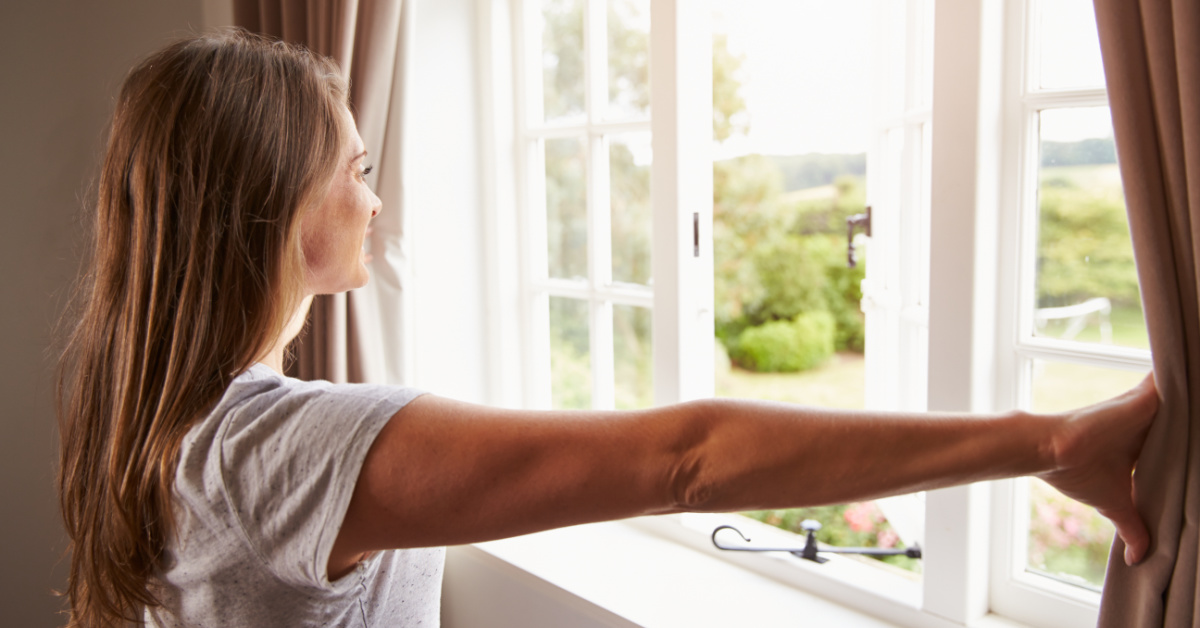
Although you can never completely rid your home of these pollutants, opening your windows for a short amount of time each day can increase ventilation and allow fresh air into your home, which significantly decreases the concentration of these indoor air pollutants.
Follow these tips to improve the ventilation in your home:
- Open windows for at least 15 minutes a day, as long as the outdoor air quality is good. (You can easily check the air quality index on a weather app or website.)
- Use the range vent and open windows when cooking, which is a significant source of indoor air pollution.
- When it’s warm outside, open the windows in the morning or at night when it’s cooler and less humid.
- When it is cold outside, open the windows in the middle of the day when it’s warmer and more humid.
- Open the windows when doing activities that easily pollute the air (like vacuuming, painting walls, or doing home improvement projects.)
- Run exhaust fans in bathrooms to reduce moisture.
Don’t Wear Shoes in the House
We already get enough air pollutants from appliances, furnishings, and products inside the home. You don’t want to add pollutants that originate from outside the home. Not wearing shoes in the house prevents many outdoor air pollutants from entering your home.
Our shoes pick up an astonishing amount of contaminants from outside, including pesticides, lead dust, bacteria including E. coli, cigarette ash, pollen, and more. Once you track these into your home, they contribute to household dust that can trigger respiratory problems when inhaled.
Here are two easy ways to prevent outdoor pollutants from making their way into your home:
- Have a “no-shoes house.” Always take off your shoes and put them on at the door.
- Place doormats at all entryways.
Clean Regularly (and Safely)
It may seem intuitive that a cleaner home is a healthier home, but some cleaning practices can actually make indoor air quality worse.
Follow these cleaning tips to improve your air quality:
Vacuum frequently (2-3 times per week)
BUT: If your vacuum doesn’t have a HEPA filter, it could be blowing some dust and particulate matter back into the air, making the air quality temporarily worse. Keep the windows open or leave the room for a couple of hours after vacuuming.
Dust Often (at least once a week)
BUT: Don’t use a dry duster, which can just kick dust up into the air. Instead, use a wet cloth to dust, as it traps the dust onto the surface. Rinse the cloth as needed.
Wash Bedding Often (at least once a week)
BUT: Make sure to wash bedding in hot water, as lower temperatures do not kill dust mites.
Avoid Using Toxic Cleaning Products
Many cleaning products contain harsh chemicals and lingering fragrances. (More on this in the next section.)
Limit Chemical Use
A big source of indoor air pollution is from products we use daily — some of which we’ve come to believe freshen our air or clean our home.
When possible, avoid using harsh chemicals in the home and instead choose cleaner options. Your go-to source for the safety of these products is the EWG. Use their database to learn more about the ingredients in products and their potential health effects.
Here are some common sources of chemical pollutants in the home:
Cleaning Products
Just because a cleaning product gets the job done doesn’t mean it’s safe. You shouldn’t be left smelling fumes or lingering synthetic fragrances after cleaning — it should smell neutral or have a subtle and dissipating fragrance from a natural source.
Don’t trust that a cleaner is safe just because it is labeled “green” or “safe.” Always look up the product on EWG to get a more comprehensive description of the ingredients.
Pesticides
Having bugs and rodents in the house can be a source of pollutants. But whenever possible, opt for natural pesticides or practices to keep these critters from entering your home.
Air Fresheners
Try to avoid using all air fresheners. Instead, find the source of odors and clean them.
Most air fresheners do not freshen the air. They often achieve a lingering fragrance by using phthalates, and the fragrances are often synthetic. Even worse, companies do not have to disclose all of their ingredients. Seeing “fragrance” on a label can mean hundreds of different ingredients that can be harmful to your health, and many trigger respiratory problems.
Candles
Wax candles are often made from paraffin wax, which is derived from petroleum. When burned, these candles release toxic chemicals like toluene and benzene (known carcinogens) into the air.
If you must burn candles, make sure you choose better options, like 100% beeswax or soy wax candles. Also, ensure the fragrances are naturally sourced and phthalate free, as companies do not have to disclose what chemicals make up their “fragrance.”
However, even the “cleanest” candle still burns, which can release soot and smaller particulate matter into the air.
Sources and Further Reading
- https://www.epa.gov/indoor-air-quality-iaq/introduction-indoor-air-quality#sources
- https://www.epa.gov/indoor-air-quality-iaq/improving-indoor-air-quality
- https://www.health.harvard.edu/staying-healthy/easy-ways-you-can-improve-indoor-air-quality
- https://www.epa.gov/indoor-air-quality-iaq/text-version-indoor-air-quality-house-tour
- https://www.epa.gov/lead/protect-your-family-sources-lead
- https://healthcare.utah.edu/healthfeed/postings/2015/04/042015_factoid-shoe-bacteria.php
- https://www.fcs.uga.edu/docs/Leave_it_at_door_HACE-E-81.pdf
- https://www.ewg.org/news-insights/news/cheatsheet-phthalates
- https://www.fda.gov/cosmetics/cosmetic-ingredients/fragrances-cosmetics
This article was written for informational purposes only and is not to be used as medical advice. Always consult your healthcare provider with questions and concerns.